Cicada Exoskeleton
As I walked along our driveway, I found a “bug” climbing on a wooden post. I stepped closer, …. As I walked closer — surprise, it was empty!
The “bug” I saw was the shed shell of a cicada 𓆣. The real cicada has already crawled out and flew away, leaving its shell behind.
Cicadas spend years underground before they finally come out, climb up, and transform into adults. Their old shell stays behind, like a little jacket from their childhood! 🪲
Feel free to download the reading comprehension: cicada_exoskeleton.pdf


Wolf Spider
I found the giant wolf spider crawling on the ground.
Unlike many spiders, wolf spiders don’t build webs to trap insects. They run fast and hunt their prey.
Wolf spiders have eight eyes in three rows. The two big shiny ones in the middle give them excellent night vision.
Even though they look a little scary, wolf spiders are helpful neighbors. They eat mosquitoes and crop pests, making them a farmer’s friend.
Thank you, wolf spider, for being our neighbor and helping us!
Tree Scar
I found this special mark on a tree. It is where a branch used to be. The tree grew a round ring to cover the spot, almost like it is healing its skin. Trees can protect themselves this way when they lose a branch. I think it looks like a wooden eye watching the forest!

Unlike humans, trees don’t “heal” by repairing the damaged wood. Instead, they seal the wound by growing new wood and bark around it, keeping the damaged part inside. This process is called compartmentalization.

I found a fuzzy caterpillar crawling on the grass. Caterpillars are the baby stage of butterflies or moths. They eat lots of leaves to get strong before changing into their adult form.
The one in the photo is a fuzzy or hairy caterpillar. Their hairs can sometimes help protect it from predators. The defensive hairs can cause skin irritation. So be careful!
Caterpillar of Green Silver-lines moth
Here is another caterpillar. It looks totally different from the above one.
What impressed me most is its bright green body with a golden like line on the back. It is amazing.
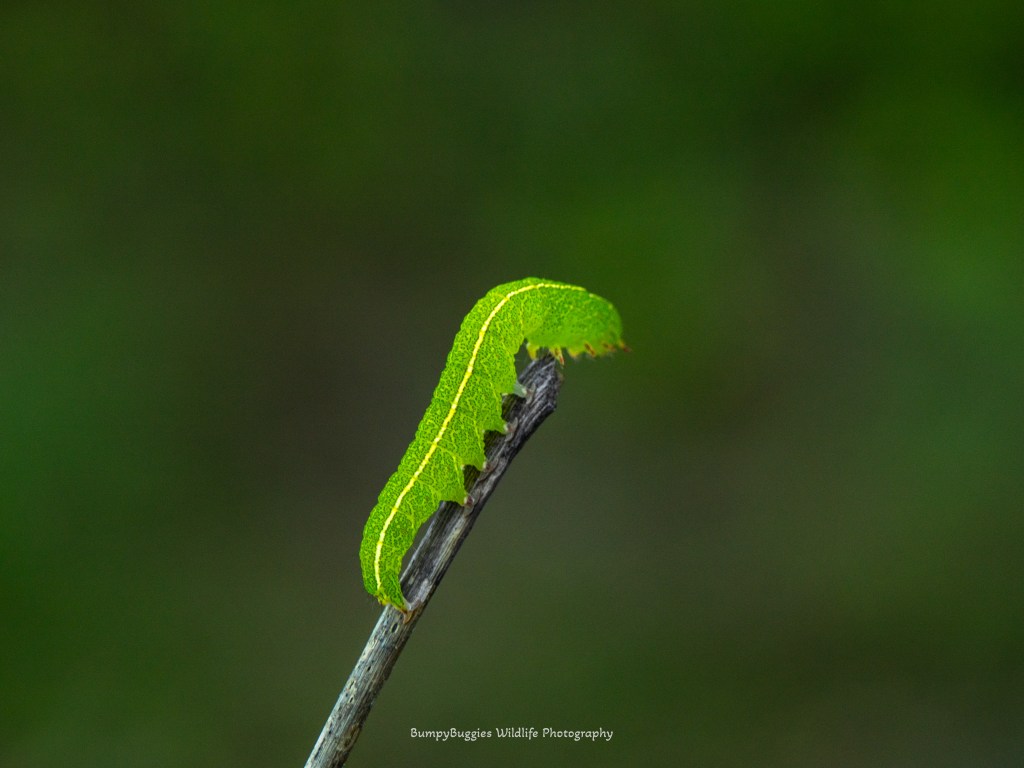
The caterpillars can be seen from July to September. And now it is the end of August.
One day, this caterpillar will turn into a shinny green moth with silver lines on its wings.
Eastern Black Swallowtail
This picture is taken in Maryland, end of August. The butterfly has black wings, white spots, and two rows of bright orange spots near its body. This is an eastern black swallowtail.
How to distinguish it from other dark swallowtail butterflies?
– Spicebush Swallowtail have a big green or blue swoosh instead of orange spots.
– Pipevine Swallowtail have a blue tail and body.
– Tiger Swallowtail have faint stripes and no spots.

 Bumpy Buggies